
 Peter agreed to be a case study for my META-Health training and gave full consent to publish the case study.
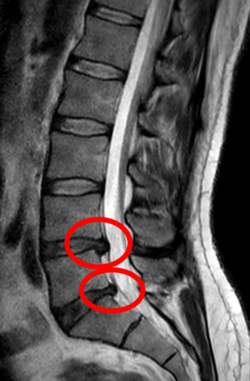
At the time of analysis, Peter was 51 years old. He had chronic back pain and was prescribed strong painkillers, which he took daily to manage the pain. He worked as a freelance sign language interpreter.
Peter stated he had “4 squashed discs” in his spine – two in his neck and two in his lower back.
Using the META-Health framework, we know the following:
- Brain Layer – the intervertebral discs in the spine relay to the Cerebral Medulla
- the Cerebral Medulla is associated with themes of self-worth/ self-devaluation.
- There is cell and tissue degradation in the stress phase and cell and tissue growth in the healing phase (-/+)
- Cervical spine – the neck can be related to moral or intellectual self-devaluation: feelings of injustice – ‘it’s unfair’, or ‘I’m stupid’, for example.
- Lumbar spine – the lower back region relates to self-devaluation linked to the individual’s core personality. Associated with an inability to cope with pressure, which can be real or is the individual’s perception.
Stress Healing Process
There are distinct points and phases a dis-ease process goes through and we can become ‘stuck’ in particular phases of that journey.
- BIOLOGICAL CONFLICT – at a basic level, a stress trigger is required to disrupt homeostasis and send an organ tissue(s) into the stress phase. The trigger can be internal e.g. thoughts, self-talk, or external – the work or home environment, sensory stimuli, an argument, etc.
- RESOLUTION – a regeneration trigger is needed to move the dis-eased organ tissue into the regeneration (healing) phase.
- HOMEOSTASIS – if the healing phase is completed, health is restored.
However, the dis-ease process can become chronic, if the biological conflict is not resolved – the individual is instead stuck in a continuous stress-healing phase loop.
Example of a recurring cycle: a school-teacher feels unable to cope with the pressures of work. The stress trigger is team meetings, where workloads are allocated. Her thought is, ‘I can’t cope with this workload; it’s impossible!’ This inability to cope with the unmanageable workload manifests as a weakened, painful lower back.
The pain is worse in the evening, when she relaxes, and first thing in the morning, – when her Parasympathetic Nervous System (rest and repair) is active. The pain lessens when she’s ‘running around’ or at work – when her Sympathetic Nervous System (fight, flight) is active.
In the parasympathetic state, repair to cells and tissues damaged during the sympathetic state occurs. However, the dis-ease process is still in the stress phase. The biological conflict is still active – there has been no resolution, such as a reduced workload, a shift in her perception/ self-talk or change in environment, e.g. a new job/career.
Once the teacher is on school break, away from the environment and stress trigger, the conflict moves into the healing phase. Pain become more noticeable, as cells and tissues grow to repair the degradation in the stress phase, strengthening her lower back.
When the teacher’s annual leave ends, she returns to school and is re-triggered by the Team meetings, sending the biological conflict back into the stress phase. She is eventually diagnosed with chronic back pain.
As part of the META-Health inquiry, we looked for the trigger that caused Peter’s body to change – an event that was Unexpected, Dramatic, Isolating with No strategy to deal with it, the ‘UDIN’.
META-Health helps us to understand what symptoms reveal about the events, beliefs and emotions contributing to dis-ease processes.
By asking a few questions, we uncovered that the injury which hadn’t healed was:
- rooted in a work accident when he was 24 years old, some 27 years earlier.
- linked to emotions and feelings that included anger and shock
- Herniated discs in Peter’s neck – the injustice (moral self-devaluation) was related to his perception that nobody thought about the repercussions of him lifting that heavy box and that he’d been in pain ever since.
- We also explored the beliefs and emotions linked to the herniated discs in his lower back, the real or perceived inability to cope with pressure, which I won’t share.
Peter was working in an office. He was standing on a little step ladder, reaching overhead to bring a heavy box down, which fell on him. He felt the discs slip in his back.
META-Meaning
Peter’s existing anger, shock, feelings of injustice and belief he was unable to cope with pressure was preventing his injuries from healing. We explored a belief and emotion, counter to the ones that created the biological conflicts in his body.
Tapping into the body’s innate intelligence
By tapping into his body’s innate intelligence – which guided us as to what was needed in order to heal – we were able to release Peter’s back and neck pain.
We used Neuro Linguistic Programming (NLP), to update Peter’s perceptions and feelings relating to the traumatic accident.
We concluded with a short meditation to illustrate how we can change our perception about life’s events, and real, or perceived pressure, by changing the relationship with our mind. I recommended he took up meditation as a daily practice.
The chronic back pain Peter had endured for more than 25 years was resolved in a 40-minute telephone consultation. He stopped taking pain medication that evening and reported years later that his back has been “brilliant” ever since.
This post was first published in 2015.

 META-Healthy Life articles are created by professionals and friends of META-Health International CIC, supporting individual and global health by deepening and sharing our understanding of how resilience and well-being are achieved.